“Sweeney Todd: The Demon Barber of Fleet Street” is a work of art that is brilliantly and sparely conceived and carried out.
Dennis Wemm
September 25, 2026
At the start, I must admit that I am a Sweeney Todd aficionado. Not just of the quasi-historical figure who supposedly racked up a far higher death toll. This is the Stephen Sondheim/Hugh Wheeler/Hal Prince musical melodrama from 1979, based on Christopher Rich’s modern adaptation of the urban legend more-or-less derived the famous first 1847 stage adaptation. I have seen it on TV and in films, and five performances at different theatres. I helped adapt the story to a live action performance art piece during my first-year graduate studies at UMass. I have known every song. Since 1981.
I will tell you now, the performance of this play at Riverside Center for the Performing Arts is the best version I have ever seen and heard. Simple as that.
The Staging
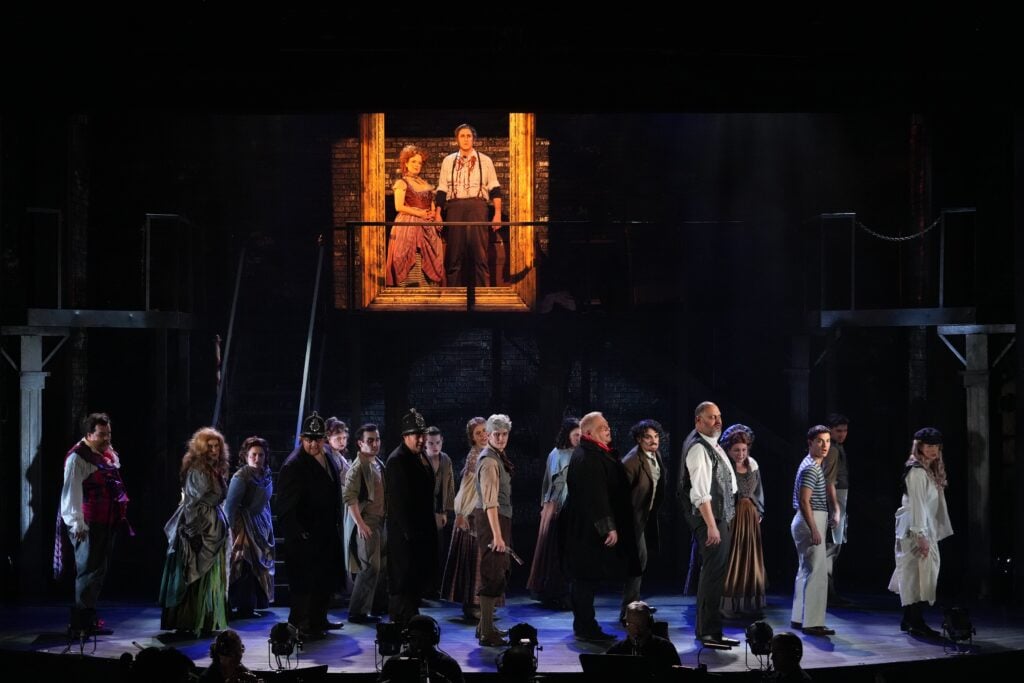
On arrival, the first thing you see is a set that is remarkably atmospheric and expresses “Victorian city.” Dark wooden stairs leading to heavy-beamed platforms that look like they were constructed to hold strong performances, an empty Shakespearean theatre built on a modern stage. There are locations over the whole stage for a performer to stop and sing their heart out (which they will continue to do for 2.5 hours with intermission). The deceptively simple structure looks like an antique playground for actors.
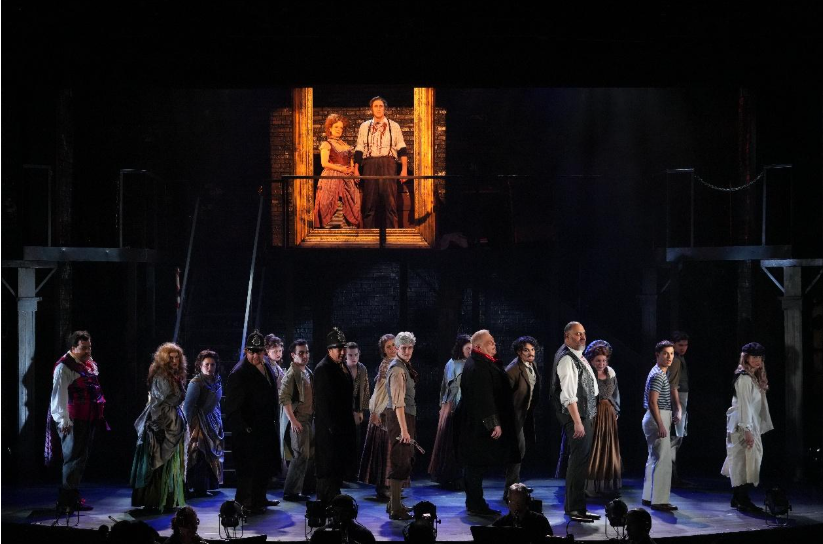
There’s a mound of masonry at the center stage which hides a grave. (My mind sang “there’s a hole in the world like a great black pit.”)
Sweeney Todd is, on the surface, a fairly grim story. The grimness never goes away and this is only the beginning.
Then, the sound (scream) of a steam whistle blasts, and a low, insinuating vamp grumbles up from the (excellent) orchestra pit. The stage populates with the whole cast. Each voice sings hushed announcements like they’re telling a story around a campfire. At each turn of a verse, the performers in perfect unison do a simple move: stop in freeze, then turn the head from the neck, looking down and over the shoulder. The gesture combines a look down on something below and an over-the-shoulder glance at a stranger following you down a dark street. The stage pictures shift until the entire cast is full-out singing “The Ballad of Sweeney Todd.”
From this point on you know you’re not in Kansas anymore. This onstage world has a story to tell, and to quote Mrs. Lovett, it’s “something not very nice.” Casual legal cruelty will lead to revenge that leads to more revenge until the mechanism of this revenge industry turns into a factory whose major product is corpses, which then become…well, you’ve probably heard about what happens next.
Except that they may have forgotten to tell you how funny, moving, and well-thought-out every moment of the play is.
The Acting
Everything in this production works. This is what happens when Riverside brings its considerable professionalism that usually supports juke box musicals to bear on a more serious work. When that happens, the performance catches fire.
This is partially true because there are some elements to the play script that have become weak spots in other productions: the role of Johanna (played by Madison Cox), outside of her role as a victim, frequently loses importance as madness catches up to her in Act II. Cox’s Johanna is emotionally and mentally fragile from her opening “Green Finch and Linnet Bird,” which makes her entire relationship with Anthony Hope (Marco Giacona) less formulaic from the outset. He’s poor but honest, a sailor through and through but he’s no handsome prince, and she’s locked in a tower and unable to reach him, but she’s no Rapunzel. Neither of them quite know what they’re getting into.
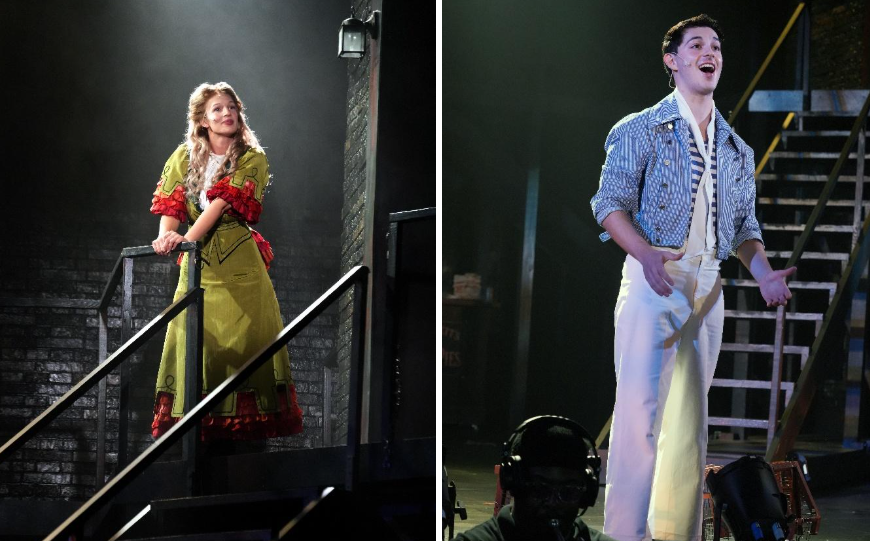
In this production the staging of the number “City on Fire!” is genuinely as disturbing as the rest of the action in the play. Not gross or even very explicit, it is simply a representation of what happens when the denizens of Bedlam take over the streets, told through choreography and simple lighting effects. This is Riverside’s most effective acting ensemble yet.
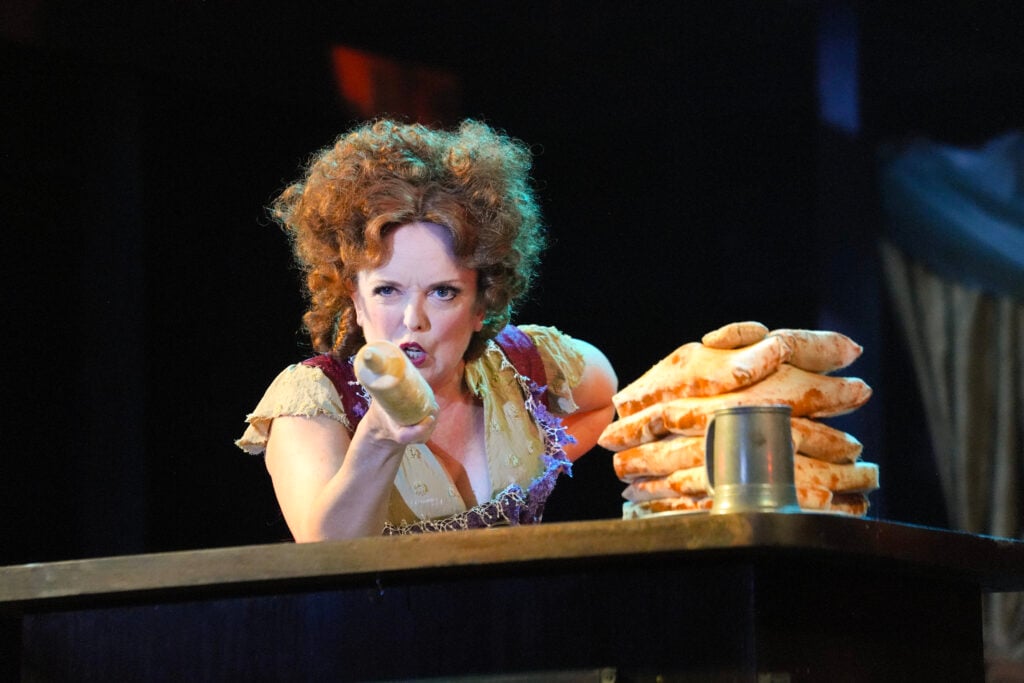
But really, the story only has two protagonists and neither is a hero: Mrs. Lovett (Nancy Anderson) feeds the masses but isn’t picky about how she does it or what she does it with. She’s so obsessed with debt that she’s become a bit of a scavenger. “Eating the pets” is not a problem for her, but she’s a little too slow to catch them these days and too broke to buy actual, legal meat for her pies.
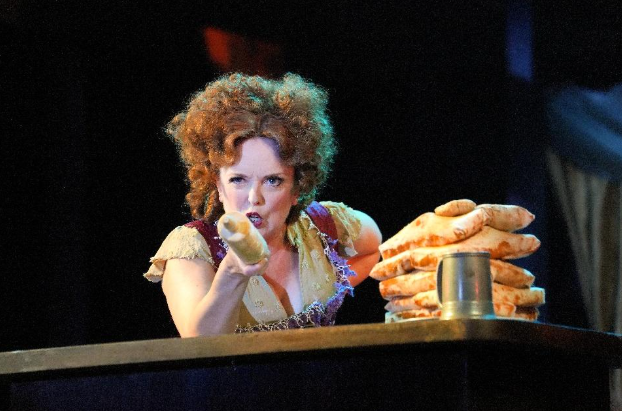
It takes a real, honest to goodness clown to portray a character so bad and make her fun to watch, and it takes an honest to goodness diva to carry off the comic singing with such serious intensity. Anderson possesses both skills, and brings them beautifully to bear. She’s on a monomaniacal course of seduction with Sweeney and carries it out with verve.
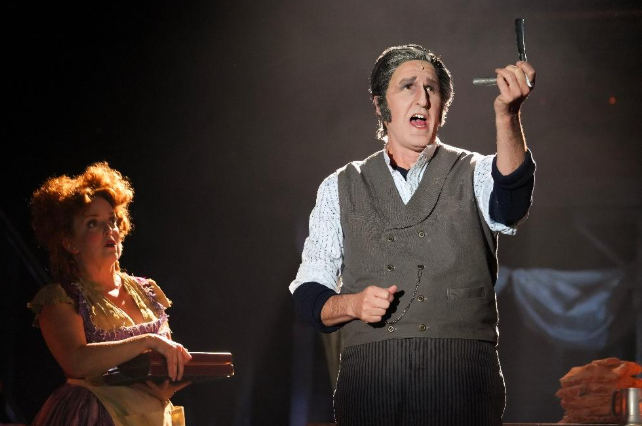
Sweeney (Christopher Sanders) is above simple humanity. His humanity has been burned away by injustice and rage but he’s going to become a secret one-man reign of terror. There is nothing left of him that doesn’t breathe vengeance and nothing stopping him from doing it. Sanders’ Lincolnesque presence and nearly complete lack of visible humor make him believable. We see straight into his soul during the keening, raging “Epiphany” number. Sweeney’s idea of a joke is when his fantasy of just revenge fits the crimes of the people he accuses. The world has treated him inappropriately and he’s set to make it right. As the play progresses, he simply kills because he’s unable to stop. He just does it one at a time, a production-line serial killer.
If Sweeney is a hunter, Judge Turpin (Andy Wynn) and Beadle Bamford (Ian Lane) are Sweeney’s ultimate prey. They are protected by the laws that they pervert to maintain their control, in their view they own the Fleet Street neighborhood. The Judge abuses his power to force women to bend to his very will; the Beadle uses his power to control and maintain public morality. And to forcibly enter their homes to play their musical instruments. The Judge imprisons men to get at their wives by false accusations, the Beadle cannot stop himself from meddling and spreading malicious gossip to maintain control. Neither suspects that they could be discovered or that some of their victims might just lose all sense of the decency.
Then there are the victims, the living wreckage of humanity that is either so unlucky or so compromised that in one way or another they are simply lost. Pirelli (Daniel Pippert) is a mediocre barber and a conman who makes a living by blackmail. The Beggar Woman (Elizabeth C. Butler) is simply never in the right place at the right time and so traumatized by her bad luck that she bumbles her way into danger at every turn. Tobias Ragg (John Sheldon) learns not to trust, because no matter what he’ll become a tool for someone more powerful or ruthless than him. Toby, though, sees all and reacts to everything.
Odds and Ends
The scene design by Christian Fleming makes a big nod to the sets for Hamilton, but it just shows how universal those sets were for staging a play set in the not-so-recent past. I favor settings where humans provide the power for moving pieces because it shows an ensemble-based production style. Theatre is, after all, human art.
Carson Ewbank’s orchestra eschews percussion and a large strings section for reeds and brass, giving Sondheim’s original score the sound of many of his other shows. Placing the orchestra in front of the stage is a little bit of mixed blessing, it definitely makes the players and instruments a visual feature of the show and greatly aids the sound balance issue but I’m very happy I was sitting on the second tier.
Costumes need to identify the character and time period and then function as a kind of signifier of social class and milieu. Costume selection and construction (plus hair design) drew my attention to the characters. All the characters were clearly defined even before the actors even started singing the opening number.
Altogether, this work of art is brilliantly and sparely conceived and carried out, each part building up the whole. The show is made up of equal parts comedy, tragedy, social satire, and melodrama (and a whole lot of glorious music). It’s not for kids but that doesn’t mean that you won’t enjoy it.
You really, really should go.
Take It In
Sweeney Todd, the Demon Barber of Fleet Street
Music and lyrics by Stephen Sondheim
Book by Hugh Wheeler
Original direction by Harold Prince
Adapted from the play by Christopher Bond
Runs September 9 through October 25, 2026
Riverside Center for the Performing Arts
Dennis Wemm is a retired professor of theatre and communication, having taught and led both departments at Glenville State College for 34 years. In his off time he was president and sometimes Executive Director of the West Virginia Theatre Conference, secretary and president of the Southeastern Theatre Conference, and generally enjoyed a life in theatre.